Are You EATING Your Financial Freedom?

Most people struggle to save money. There are so many urgent and important items that compete for every single dollar in our wallet.

The kids are constantly growing out of their clothes, something in the house is continually breaking down, and the car seems to have a ravenous appetite for money. These are all items that consume our money, but the largest competitor for savings in most people’s household is FOOD. In fact, when someone completes their first-ever budget, they begin to review their actual spending patterns and nearly always come to the same conclusion that they’ve been spending way to much on food. They summarize their discovery by stating something like:

“I’ve found out where my savings account is – I’ve been eating it!”

I discovered this truth when I did my first budget way back in July 2003! The realization is as stark today as it was then. I was literally eating my savings (and my future)!

There are many ways to reduce your food costs (and I would love for you to share your great ideas with us all in the comments!):

  1. Don’t go to the grocery store when you are hungry!
  2. Split a meal with someone else while at a restaurant.
  3. Use cash envelopes
  4. Shop the sales at the grocery store!
  5. Use coupons (but buy things you will really use!)
  6. Make dinners from scratch (healthier and brings family together!)
  7. Designate one week as a “We’re eating all our meals using stuff in the pantry this week!” (you will quite possibly have the most interesting meals you’ve ever had!)

Readers: What additional ideas would you share? Click HERE to share in the comments!

Read recent posts

Food Stamps For Your Kitty Cat?

File this one under “Weird”.

I recently had an article sent to me by my friend, and I have been stunned ever since.

Did you know that there is a Food Stamp Program for PETS?

You can read an article about it HERE.

What are your thoughts?

Read recent posts

SERIES: “Fix The Economy” – Make Rip-Off Loans Illegal

Welcome to the latest series at the wildly popular JosephSangl.com: “5 Things That Will Help Fix The Economy” In this series, I will be sharing some principles I believe will help fix the economy long term.

The economy has been stuck for some time. The words “Great Recession,” “Fiscal Cliff,” “Sequestration,” “Stagnant,” and “Jobless Recovery” have become common everyday language.

Number 5:  Make rip-off loans illegal

I know this seems a little out of place when compared to the other four items, but I really feel this needs to be included. When economies allow organizations to charge OUTRAGEOUS fees and interest to citizens, it is positioned to eliminate the middle class.

In a coaching appointment, I had a person who had signed up for a “payday” loan. The loan agreement clearly outlines that the “annual percentage rate” was 782.14%. That is not a typo! The interest being charged to this person was 782.14%.

I’ve heard arguments from those who make these types of loans:

  • We help people who are “in a pinch”  You can actually say that with a straight face?
  • People voluntarily sign up for these loans.  This doesn’t make it right!
  • These are smaller loans, so it’s not that big of a deal.  Yes, it is!

Have you noticed where these rip-off loan businesses are located? Near rich neighborhoods? Nope. They are located next to communities where people have little money education. It’s my goal to help educate everyone to the point that no one would ever borrow money with such horrific financial terms and these types of organizations have to go out of business!

This type of lending is awful, and it should be illegal. Who’s with me?

Read the entire series (available after 3/14/2013)

Read recent posts

SERIES: “Fix The Economy” – Incentivize Innovation, Job Creation, and Education (Especially Money Education)

Welcome to the latest series at the wildly popular JosephSangl.com: “5 Things That Will Help Fix The Economy” In this series, I will be sharing some principles I believe will help fix the economy long term.

The economy has been stuck for some time. The words “Great Recession,” “Fiscal Cliff,” “Sequestration,” “Stagnant,” and “Jobless Recovery” have become common everyday language.

Number 4:  Incentivize Innovation, Job Creation, and Education (Especially Money Education)

Economies that possess highly educated people who focus on developing emerging technologies are the ones who help drive job creation. For this reason, it is essential that countries incentivize this because it will result in global economic improvement.

There are so many great areas where we need innovation:

  1. Transportation: Rapid transit and mass transportation
  2. Energy: Electricity, Oil, Gas (improving the old ones) and Renewables (replacing the old ones)
  3. Housing: Improving efficiency and building materials
  4. Education: Improve teaching and learning methods – especially providing experiential learning and connecting theory to real-life application

Here’s why money education is so important:

People without sound money knowledge will do the only thing they have ever seen done with money – spend it. They will spend every dime they have earned, then open a credit card and proceed to spend all of the credit limit also. This WILL help power an economy – but only for a very brief period. Very quickly, those people who have little money knowledge will run out of spending power and have to repay their debts. This causes economies to experience short-term massive expansion followed by years of stagnant growth or even contraction. Sound familiar?

While steady growth is not nearly as exciting as massive expansion, it is sustainable.  That sounds like a good deal to me.

Read the entire series (available after 3/14/2013)

Read recent posts

SERIES: “Fix The Economy” – Build Substantial Financial Margin

Welcome to the latest series at the wildly popular JosephSangl.com: “5 Things That Will Help Fix The Economy” In this series, I will be sharing some principles I believe will help fix the economy long term.

The economy has been stuck for some time. The words “Great Recession,” “Fiscal Cliff,” “Sequestration,” “Stagnant,” and “Jobless Recovery” have become common everyday language.

Number 3:  Build substantial financial margin.

When an individual, organization, or government continually operates without a “margin of safety” financially, they are always are at risk of collapsing in the face of a financial emergency.

Over the past decade, the national debt of the United States has soared. The actual debt was:

  • In 2000: $5,757,000,000,000
  • In 2004: $7,097,000,000,000
  • In 2008: $9,472,000,000,000
  • Now: $16,614,000,000,000

This debt has increased in large part because the nation has been “against the wall” financially – with no real savings. Just like a person who has lost their job without having any saved money, the decision was made to “finance” the gap to keep everything running. However, just like a credit card has a spending limit, so does the nation.

Just as it is of first and foremost importance for an individual to build financial margin (even before attacking debt), it is vitally important that the nation build savings. Savings allows the nation to have “breathing room” that would allow for the conversations and dialogue that is very necessary to make the best and wisest decisions regarding income and outgo.

Here are ways that the United States could build margin:

  1. Pass a balanced budget that is REQUIRED to be followed. (This was part 2 of this series)
  2. Ensure that savings is included as an expense that is part of the balanced budget.

I would be more than happy to pay more taxes if the government’s leaders would commit to STOP incurring more debt, and my extra tax dollars would be utilized to build financial margin and to reduce debt. Anything to ensure that my children and grandchildren won’t be left bearing the huge financial burden of a bankrupt nation!

Your thoughts?

Read the entire series (available after 3/14/2013)

Read recent posts

SERIES: “Fix The Economy” – Require A Balanced Budget

Welcome to the latest series at the wildly popular JosephSangl.com: “5 Things That Will Help Fix The Economy” In this series, I will be sharing some principles I believe will help fix the economy long term.

The economy has been stuck for some time. The words “Great Recession,” “Fiscal Cliff,” “Sequestration,” “Stagnant,” and “Jobless Recovery” have become common everyday language.

Number 2:  Require a balanced budget.

In all of my personal finance books, events, and teaching, I share a fundamental and foundational financial truth that the following formula applies to one and all if we truly want to prosper:

INCOME – OUTGO = EXACTLY ZERO

If “Outgo” continually exceeds “Income”, then the formula won’t equal “Exactly Zero” (EZ tm!) Instead, it will be a negative number. This can go on for awhile through the use of debt and creditors, but eventually the game will come to an end and the creditor will shut off future funding.

Balancing a nation’s budget requires the same process you and I put into place at our kitchen table. When faced with a negative number instead of “Exactly Zero,” there are two ways to balance the budget:

  1. Increase INCOME
  2. Decrease OUTGO

1.  Increase INCOME

How does a government increase income? Generate more tax revenue! This can be achieved two ways: (i) Increase taxes or (ii) Economic improvement (which will yield more taxes as profits and payrolls increase). While most of us are not terribly excited about paying taxes, I am more than happy to pay them to enjoy the good benefits that government provides. I would be even happier to pay taxes if I knew that the government was required to have a balanced budget!

There’s actually a third way to increase income, and it’s my least favorite: (iii) Borrow money. Borrowed money generates money for now, but creates a future liability that adds to future “OUTGO.” A good way to comprehend this is a credit card. You could use your credit card right now to generate income. You could purchase items and “stimulate your economy” right now because it would add to the “INCOME” side of the equation. However, the bill would come due soon and cause the “OUTGO” side to increase. Seems very counter-productive to me! I’ve yet to meet anyone who told me that borrowing a ton of money on their credit card was a great decision that helped them prosper!

2. Decrease OUTGO

This is the unpopular and unsavory part of budgeting. No one wants to reduce spending because that’s our favorite part! We all want to be able to shop, subscribe to cable and Internet service, drive a great car, and have the best of everything, but decisions must be made when faced with substantial budget issues. Using the credit card to fund these items during a slump in income will only work for awhile and then the bill will come due – larger now because of failing to make key decisions and using the credit card instead.

Sometimes in our personal budgets, we must even reduce and potentially eliminate good things and fun activities. We don’t WANT to, but we MUST if we really want to position ourselves to prosper long term. The same is true for governments. When faced with tremendous INCOME challenges, we must reduce and eliminate OUTGO – even for great programs and organizations! It is awful and no fun, but it is NECESSARY if there is to be any fundamental financial and economic improvement!

Let’s look at the United States Budget (see it all HERE). According to the non-partisan Congressional Budget Office, the U.S. collected $886 billion in INCOME during the first four months of Fiscal Year 2013 (FY2013). However, the country spent $1,181 billion in OUTGO during the same period. Our key equation “INCOME – OUTGO” definitely is not EZ! Instead, there is a deficit of $295 billion. Put simply, for every $1.00 the country collected, the government spent $1.33.

To better comprehend these huge numbers, let’s put this in terms of your personal household income. Suppose you earned $4,000 this month. To match the deficit achieved in the first four months by the government, you would need to have spent $5,331 or $1,331 more than you earned. How long could YOU sustain that type of deficit spending?!?!

A vigorous debate must be done with the vision of a great economic future as the main goal – instead of a “I need to win this argument at all costs” posturing and positioning. There will be tough decisions that will impact people, services, and the global economy. It is a huge and complicated task (so is balancing our own budget!), but it must be done to fix the economy long-term.

Your thoughts?

Read the entire series (available after 3/14/2013)

Read recent posts

SERIES: “Fix The Economy” – Establish a Clear Vision

Welcome to the latest series at the wildly popular JosephSangl.com: “5 Things That Will Help Fix The Economy” In this series, I will be sharing some principles I believe will help fix the economy long term.

The economy has been stuck for some time. The words “Great Recession,” “Fiscal Cliff,” “Sequestration,” “Stagnant,” and “Jobless Recovery” have become common everyday language.

Number 1:  Establish a clear vision of what we want our economy to look like

“Without vision, the people perish” is absolutely true. This applies for each of individually as well as for all of us corporately. If we don’t have a crisp, clear, and compelling vision for the future that is fully bought into by leadership as well as all citizens, the economy will waver and wander.

  • President Obama has been sharing his vision for the United States HERE.
  • Canada’s prime minister, Stephen Harper, shares vision HERE.
  • Mexico’s president, Enrique Pena Nieto, wrote a book about his vision for Mexico HERE.

Here is what I know to be true:

If it always one party completely FOR something and the opposing party completely AGAINST something, progress can hardly be made. Relationships become toxic and non-productive and every issue becomes a “WE versus THEY” battle. Economic progress and stability happens when vision is vigorously debated, everyone has their moment to hear it and have their questions answered, and buy-in from all representatives is achieved. Impossible, you say? It has happened many times in the past – usually in the face of tremendous adversity. What if we viewed our collective global economy as a moment of tremendous adversity?

Maybe this would be a good start to a global vision statement:

Help people accomplish far more than they ever thought possible.

Read the entire series (available after 3/14/2013)

Read recent posts

SERIES: 5 Key Things That Will Help Fix The Economy

Welcome to the latest series at the wildly popular JosephSangl.com: “5 Things That Will Help Fix The Economy” In this series, I will be sharing some principles I believe will help fix the economy long term.

The economy has been stuck for some time. The words “Great Recession,” “Fiscal Cliff,” “Sequestration,” “Stagnant,” and “Jobless Recovery” have become common everyday language.

In this post, I will share my 5 Key Things That Will Help Fix The Economy, and then we will dive into each one to understand why it is important to long-term recovery.

  1. Establish a clear vision of what we want our economy to look like
  2. Require a balanced budget
  3. Build substantial financial margin
  4. Incentivize innovation, job creation, and education (especially money education)
  5. Make rip-off loans illegal

These are 5 key things I believe will position the economy for long-term health and sustainable growth. I look forward to having a conversation with you over the next several days regarding each of these items. TOGETHER -WE can make a difference for the world.

Read the entire series (available after 3/14/2013)

Read recent posts

OWE or OWN?

Two words: “OWE” and “OWN”

The words share the same first two letters, but the third letter makes all the difference!

When you purchase a car with cash, you owN it. If it is financed, you owE it.

Here’s the difference the third letter makes:

  1. A different future.  Owning equals no future payments. Owing means you’ve pledged away future income.
  2. Stress.  Owning equals reduced stress. Owing means HAVING to produce income just to hand it over to the bank.
  3. Relationship.  Owning equals positive relationship. Owing means there is a unique “borrower-lender” relationship where the lender has the right to bother and hassle you should you fail to meet every part of the lending agreement.

Do you OWE or OWN?

Read recent posts

My Favorite Sources for Financial Knowledge

I seek to learn something new about money every single day.

Every. Single. Day.

The sources are wide ranging. I learn from:

  1. Leaders
  2. Organizations
  3. Magazines
  4. Books
  5. Conferences
  6. Blogs
  7. Major websites
  8. Observation of people
  9. Personal experiences
  10. My family

But none of these are as good as the best source that I’ve used to gain proven financial wisdom and knowledge: The Bible.

There are stories of feast AND famine. Moments of wealth AND poverty. More than anything, I’ve discovered that if I would:

  1. Read the Bible, and
  2. Put the teaching and wisdom into practice

I would maximize every dollar I’ve been blessed to manage.

I’m convinced the same is true for every living being. This is why I’ve written many blog posts as part of the “Biblical Financial Lessons” series. They can help you get from where you currently to living the fully funded dream you have in your heart.

Read recent posts

Are You Able To Handle A Major Financial Disruption?

I was recently on a flight that had a connection in Charlotte, NC. Charlotte, however, experienced a little snowfall. I say “little” because I grew up in Indiana. But for Charlotte Douglas International Airport, it was a MAJOR deal! My 5:55 PM flight was missed. So was the 8:05 PM that I was reassigned to. After it was delayed to 8:30 PM, 9:00 PM, 10:00 PM, and 10:30 PM, it was canceled. Then my 10:20 PM reassignment was delayed to 10:25 PM, 10:50 PM, 11:05 PM, and 11:20 PM. Nearly all inbound flights had people stranded on planes for over two hours as they attempted to navigate the pile of planes on the ground and de-icing stations that had been established. It was awful, and it leads to the bottom line.

The Bottom line: Charlotte Douglas International Airport was not equipped to handle this disruption very well.

It made me think of my financial situation and ask this question: “Am I prepared to handle a MAJOR financial disruption?”

Most of us will face a MAJOR financial disruption at some point in our life, so we must be prepared for it.

So, let me ask you the question: “Are YOU prepared to handle a MAJOR financial disruption?

Read recent posts

MONEY LIE: I Can’t Give Money Away and Still Make It Financially

Welcome to the “Money Lies” series here on the wildly popular JosephSangl.com. In this series, I will be sharing many common money lies that people believe.

MONEY LIE #6: I can’t give money away and still make it financially.

Yes. You. Can. I’m convinced that my giving keeps me from becoming greedy and a “Me. Me. Me!” person. When my bride and I prepare our monthly budget, we put giving in our budget first. We give far more than 10% of our gross income away. It is our passion to invest in our church and in others. We love helping fund the dreams of others and investing in life change. There was a time when we were broke that we didn’t give much away. Since we weren’t giving and we were broke, we decided to do something different: we began giving – even though we were broke.

It completely transformed our life.

Giving connected us to the fact that we could partner with others to accomplish great things and to fund causes we fiercely believed in. It allowed us to be part of something much greater than ourselves. It made us keenly aware of the need to manage the remainder of our money in a trustworthy manner – or else we couldn’t continue giving!

If you’ve never given, I urge you to begin right away (like NOW!). Here are some practical ways to GIVE and still prosper:

  1. Prepare a written monthly budget and put giving in FIRST (not last).  If you wait to see if something will be left, there never will be anything remaining. It must be a priority.
  2. Determine WHY you are giving.  If you are giving because someone made you feel guilty, your commitment to giving won’t last. You have to KNOW why you are giving – and BELIEVE in what you are giving toward.
  3. Put Giving FIRST and Saving/Investing SECOND.  This is how Jenn and I manage our budget. It ensures that our priorities are always funded before anything else. By the way, we view our saving/investing as a means to give BIG-TIME in the future.

Read the entire series (available after 2/20/2013)

Read recent posts

MONEY LIE: I Can’t Budget

Welcome to the “Money Lies” series here on the wildly popular JosephSangl.com. In this series, I will be sharing many common money lies that people believe.

MONEY LIE #5: I can’t budget.

This is so common. People are busy. They hate math. Their spouse is impatient about money. They have “seasonal, cyclical, or irregular income” and that makes it more difficult to budget.

Here’s the deal. I KNOW it is difficult to prepare a budget. I’ve been told that by many people. They share that it is difficult expecting that to make it okay to not prepare a spending plan. My question is this: “Difficult compared to what? Not budgeting?”

I don’t know all of the reasons that people choose not to budget (and it is a choice), but here’s one thing I will fight about: A BUDGET SET ME FREE!!!!!

  • A budget allowed me to know exactly where every single dollar was going BEFORE I was ever paid.
  • A budget provided choices to me – because I was planning it before I received it.
  • A budget brought my bride and I together and put us on the same financial page.
  • A budget allowed me to pay off all of my non-house debt in 14 months.
  • A budget allowed me to pay off my house in 10 years and 1 month.
  • A budget has allowed me to launch two businesses and purchase another.

In case you can’t tell, I am more than a little passionate about this topic. To put it all into a simple sentence: “You need a budget!”

Here are some practical ways you can make a budget work well for you:

  1. Use a budget tool.  This allows the math to be done automatically for you, and that means you can focus on the financial decisions instead of a facing a terrible math quiz. Use our FREE BUDGET TOOLS – they do all of the math for you!
  2. Build an emergency fund equal to a full month of EXPENSES.  This is EXPENSES – not INCOME! Once you’ve saved enough for an entire month of expenses, you can ignore multiple paychecks each month, and use the Monthly Budgeting Tool instead. And you will rid yourself of a level of stress you didn’t even know you were dealing with!
  3. Be realistic.  If you are just beginning to prepare a monthly budget, it is important to be very realistic on your expenses. Do not tell yourself that you will spend $2.81 on groceries in the next month. That’s not possible, and it sets you up to fail. If you have a household of kids that are involved in 83 activities, don’t put $0 in your “dining out” part of the budget.
  4. Read the “How Do I Budget SERIES”. You can read that HERE. It will really help you as you launch into the wonderful world of budgeting!

Read the entire series (available after 2/20/2013)

Read recent posts

MONEY LIE: I Can’t Save and Invest Money

Welcome to the “Money Lies” series here on the wildly popular JosephSangl.com. In this series, I will be sharing many common money lies that people believe.

MONEY LIE #4: I can’t save and invest money.

This is the lie that keeps people broke for their entire lives. When we are young, we believe we have forever to prepare for retirement. After all, young people and young families need to provide for their household, their children, and are just starting out in life. There never seems to be enough money to put away for a rainy day or for the future.

If you tell yourself this money lie, there never will be enough money to save or invest. If this is you, TODAY is the day you stop believing the lie and begin funding the future! Here are some practical steps you can take toexplode your financial future:

  1. Understand compound interest.  Compound interest is what will allow an investment of $100 per month to reach $1,176,477 in just 40 years! If you just save a little ALL of the time, you will end up with a LOT at the end of your time! Use our “Investment Value Calculator” to see how much you could save!
  2. Take advantage of retirement plan matching.  If you work for another company or organization, there’s a good chance your retirement plan contributions are eligible for matching contributions from your employer. Whether it is a $0.50 per $1.00 match or a full “dollar for dollar” match, it is FREE money! Visit your Human Resources Department TODAY to ensure you are receiving the full company match.
  3. Make saving and investing MONTHLY (at least) and AUTOMATIC.  If you have to rely on yourself to write a check each month, your savings plan could be in great danger! Make it automatic – have it deducted from your paycheck before you ever receive it or have it zapped out of your bank account at a predetermined date each month.

You will be on your way to becoming a wealthy individual who will be able to live a life of generosity like you’ve never dreamed!

Read the entire series (available after 2/20/2013)

Read recent posts

MONEY LIE: I’ve Made Too Many Financial Mistakes to Win with Money.

Welcome to the “Money Lies” series here on the wildly popular JosephSangl.com. In this series, I will be sharing many common money lies that people believe.

MONEY LIE #3: I’ve made too many financial mistakes to win with money.

This is one of the most common lies that people tell themselves. The believe that because they’ve … (insert financial mistake here – declared bankruptcy, had their car repo’d, run up a pile of medical bills without health insurance, are way upside down on a home, had a business fail, etc.) … then it is not possible for them to win with money.

Let me respond to this with one word: “FALSE!”

You CAN win with your money – regardless of financial mistakes you’ve made. Don’t let past mistakes and your current situation control the rest of your life!

Here’s what I know to be TRUE: If you deal with the issues NOW, the problems you are currently facing won’t even be able to be seen in your rear view mirror two years from now.

Many people respond to me with a statement that starts with “But Joe …” and then they provide all of the reasons (excuses) why they can’t make progress.

If you’ve been believing this Money Lie, then here are some practical steps you can take to begin winning again:

  1. Clarify your actual financial situation.  Many people who believe this money lie become overwhelmed, throw their hands up in the air, and give up. As a result, they no longer have a firm grasp on the truth of their financial situation. Here are two tools that can help big time: Budget & Debt Freedom Date Calculator. They are both FREE right HERE. A budget will help you understand your monthly situation. The debt freedom date calculator will help you understand your overall financial indebtedness.
  2. Have “I CAN DO THIS!” printed on a card and put it where you can see it.  I encourage you to put Philippians 4:13 on it as well.
  3. Make a decision to “make tough decisions” and TELL SOMEONE about the decision.  There are few things in life that will help you get tough decisions implemented like implementing accountability with someone you love and trust.
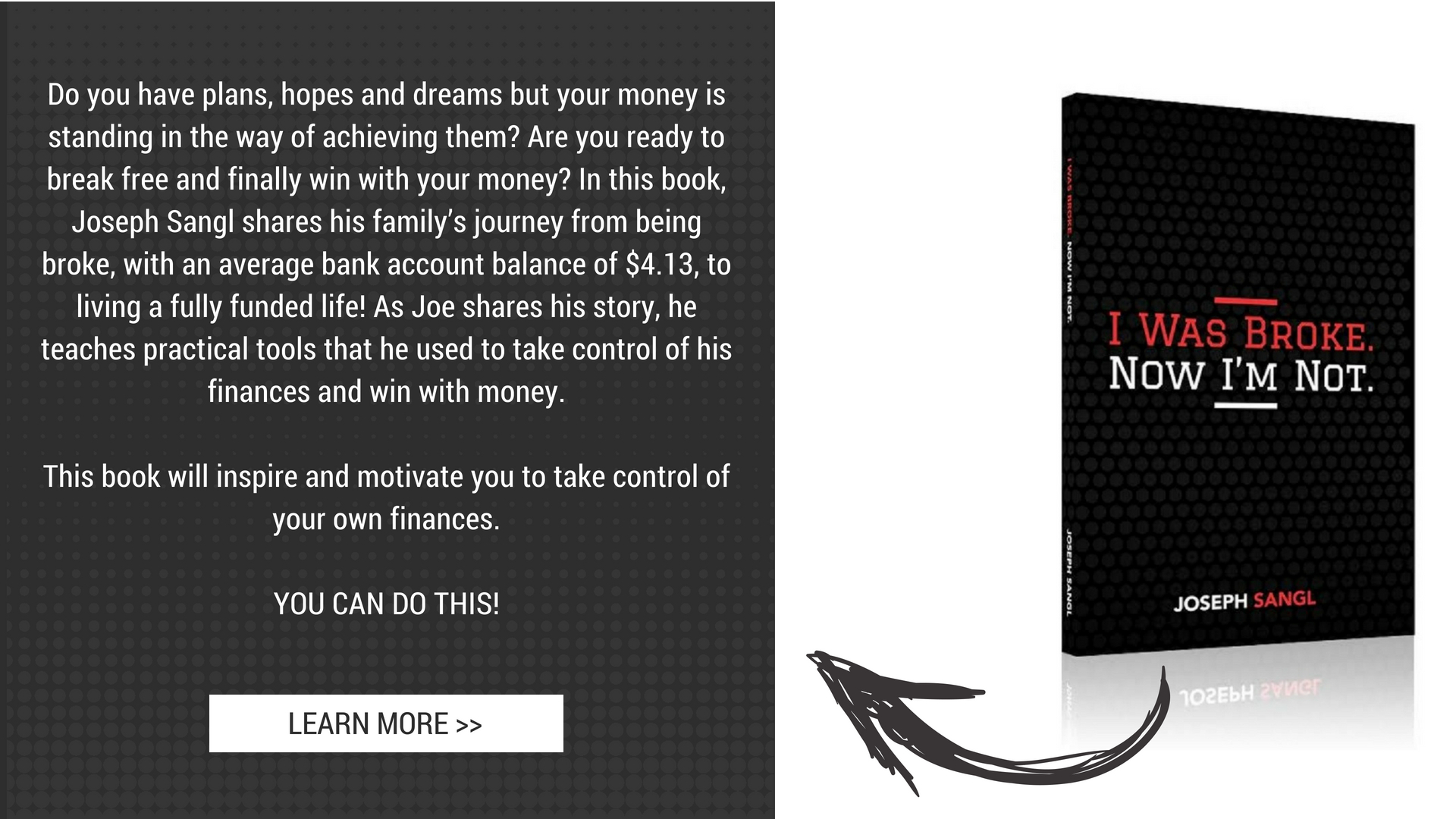
  4. Gain wisdom.  Get wisdom from people you know that have won with money. Buy books from all the financial teachers (at least the ones that have actually won with their money – there are quite a few broke financial advisers out there). Read one book per month on personal finances for the next year. Start with I Was Broke. Now I’m Not. (mine – it’s how I won with money). Then read Dave Ramsey’s Financial Peace, Revisited.  After you read those two, send me an email and ask for the next reading assignment – I have a list of more than 40 books you need to read!

Read the entire series (available after 2/20/2013)

Read recent posts

Page 3 of 116«12345»102030...Last »