Saving
5 Questions to Ask Before Spending Money
Do you ever get caught in the cycle of “see it, want it, and buy it?” Before you spend you don’t stop to think through your purchase. Now you not only have a new gadget that’s all yours, but you also have a high monthly payment to go with.
It is my hope that this post will help provide you with practical questions to ask before you spend a substantial amount of money. Practical questions that will help you truly understand the enormity of the decision, and help you make the decision that is best for you and your family.

Question 1: “Do I need this?”
This can seem very basic, but as a “spender” I can get caught up in the “I WANT THIS!” moment and never stop to ask, “Do I need this?”
My garage is full of “I WANT THIS!” items that we never use. EVER! This includes a RC Airplane (it’s cool – but I don’t use it), bike (never ride it), tennis rackets (once every three years – not a priority), and many other items.
Pausing to ask, “Do I need this?”, can prevent a lot of poor spending decisions. I’m not saying that I never purchase things that are pure “wants” – I am saying that when I ask the key question, I make much smarter overall decisions.
This question becomes a “gate keeper” of sorts. Something to help prevent impulsive spending. If you are an impulsive spender, and need help to stop check out this post [HERE].
BONUS: Wait overnight before answering the question! It is amazing the clarity that a good night of sleep will bring to a spending decision!
Question 2: “Will this item INCREASE or DECREASE in value?”
Asking this simple question can prevent a lot of poor spending decisions!
Chewing gum goes down in value. So do cars, 4-wheelers, refrigerators, swimming pools, and clothes.
Businesses can go up in value. So can houses, land, antiques, mutual funds, company stocks, bonds, and intellectual property (patents, licenses, etc).
Here is what I KNOW: Not all of your purchases can be for items that increase in value, but if ALL of your purchases go down in value – something ain’t right!
BONUS: Find someone you know who is prospering with their investments. Invite them to lunch (pay for his/her lunch) and ask them to mentor you! They will probably LOVE IT!
Question 3: “Do I have the money to pay CASH for this item?”

I got to write the “I Was Broke” part of my book, I Was Broke. Now I’m Not. (you should buy a copy HERE) by always financing stuff. My car, truck, next truck, engagement ring, wedding ring, honeymoon, credit cards, college student loans, furniture, and many other things were financed because I did not stop and ask myself this key question. I know that the day I started asking this question was THE DAY that my family started winning with money.
If I do not have the cash to pay for it, I’m not buying it UNLESS it is a house or an asset that will increase in value (like a business, rental house, etc). Even then, the answer is still usually “NO!” unless I have all of the money available to pay cash.
Question 4: “Will this purchase generate income for me or take income away?”
What an incredible question to ask – and what a difference it will make in the way you think about money! I used to earn money and then immediately begin pondering which fun item I was going to buy. I rarely (if ever) thought about the fact that I could use the money to buy in to a small business, purchase stocks and mutual funds, start a small business or purchase a rental home.
Even more, I did not truly realize the ACTUAL cost of many of the items I had purchased. I had purchased a new car (my smokin’ hot Chevy Cavalier) and I only thought of the bank loan as my “cost” to purchase. In actuality, I also added the costs of insurance, property taxes, license tags, maintenance, repairs, and additional gasoline consumption. Not to mention the lost potential to make money with what I was currently sinking into all the bills associated with that car.
Before you spend, just stop and ponder the options available to you to use those resources to generate more income for you in the future.
BONUS: Review your budget to see how much your current possessions are costing you on an ongoing basis. There are many purchases that are “gifts that keep on giving.” By looking at things you’ve already purchased, or subscriptions you already have, you can find ways to lower your expenses.
Question 5: “Will this help me achieve my future plans, hopes, and dreams?”
I believe that the number one reason that people fail with their financial plans is a lack of organization and the lack of a plan. One of the best ways to plan your finances is to budget each month. To learn more about budgeting check out this post [HERE]. Budgeting is planning where you spend your money with you long term goals in mind.
Without a longer-term perspective, it becomes extremely easy to fall into the trap of living for the minute, and immediately spending every single dime we earn. As one develops a longer-term perspective, it really helps us recognize that spending all of our money right away will rip our future dreams away from us!
When my family first got started on improving our financial future (Dec 2002), I noticed that we started looking a few months ahead. Now, eighteen years later, my entire perspective has shifted. You see, I want to leave a legacy for my children and community. I want to leave a huge inheritance to my family, church, and others. My wife and I want to give our children a paid-for college education. We want to give them a paid-for house when they graduate. We desire to teach them to manage their finances recognizing that it is not just FOR THEM, it is FOR THEM TO HELP OTHERS!
I’m 46 right now. Statistics say I am over 1/2-way through my life. Time is short. Too short to spend all of our resources on stuff that does not support our plans, hopes, and dreams.
This is also why I wrote the book 20/20 Money. I wanted to walk you through practical steps you can take to not only discover, but fund your God-given purpose. Too often I see people buy into the lie that their big dreams aren’t possible because their income just won’t support it. My book is about helping you move forward to live a Fully Funded Life.
So Before You Spend…
THINK! Think about what this big purchase means. Not just the temporary gratification, but how it will impact you in the long run.
My hope is that by slowing down and asking yourself these questions you will be able to gauge how important a large purchase is to you, and how it will benefit you. You will make fewer, more meaningful purchases. You’ll still get to indulge in some “I wants,” but you’ll notice there will be less times that you spend money on something and wonder later “Why did I buy that?”
Back to School?
School supplies? What does school even look like this year?
If you’re a parent, you are probably wondering what back-to-school will look like this year.

Maybe you are waiting for your school district to announce their plans for the year, or possibly the year’s start has already been delayed. Parents are trying to decide between a multitude of options – send the kids back to classrooms full time, hybrid schedules mixing in-person and online, eLearning through your school district, co-ops with other parents, or homeschooling.
There is a lot of uncertainty right now about what this school year will look like. So whatever you are gearing up for, we want to help.
Where do you start when it comes to scoring great deals on school supplies? Below is a list of tips and tricks for back-to-school shopping compiled by one of the I Was Broke. Now I’m Not. team members, Whitney Purcell, along with a few of our other moms. Whitney is a mom of two little girls (3 and 6) and has spent a great deal of time researching back-to-school deals.
When to Shop for School Supplies
Knowing when to shop can help you save a lot of money. We suggest checking to see if your state has a tax-free weekend and when retailers are planning to run specials.
Tax-Free Weekend
Shop during your state’s tax-free weekend is a great way to save money. You not only avoid paying sales tax on clothing and school supplies, but most retailers run specials that weekend as well.
Before you head out to do your shopping, do your research. Different states have different restrictions on what is tax-free. While most states include school supplies and clothing, you’ll want to check in advance. To see when your state’s tax-free weekend is and what it covers, click HERE.
If you are in a state that doesn’t offer a tax-free weekend, it could be worth driving to another state close by, especially if you need to purchase high priced items. Growing up in Kansas, we didn’t have a tax-free weekend, but Missouri was only a 30-minute drive, so going there to purchase back-to-school clothes and supplies was worth the trip.
This year some states, like Tennessee, are planning to have two tax-free weekends!
Store Specials
Another great time to shop is when a retailer is running specials. Check out stores like Target, Walmart, and office supply stores to see their specials. Typically this will start the beginning of August. Remember, you don’t have to purchase all of your supplies at one store – by shopping ahead of time, you can figure out where to buy what to save the most money.
You know Walgreens? Well, it isn’t just your drug store on every corner. Walgreens carries school supplies as well. While they aren’t the best priced, they offer great specials throughout the year, which includes deals on school supplies. Check out their weekly ads and coupons to see if school supplies are on there.
Where to Shop for School Supplies
You may feel like you are bombarded with options when it comes to where to shop. Don’t look past the unexpected locations, though.
First Get a Rebate
Before you use any of the store websites on our list, you should use Rakuten to get cashback your purchase. Once you sign up for a Rakuten account, you can add their browser app which will notify you when they have cashback for a participating retailer.
If you don’t like the browser extension, you can also go to their website before visiting an online store. For example, I just logged into my account, did a search for Target, and it came up with 1% cash back. I click on the Shop Now button and it takes me to Target’s website.
That’s it! Whatever I purchase I get 1% cash back. The amount of cashback varies greatly by store. I have seen as much as 22% cashback at some small retailers or on specific items, but it is usually around 2%-3%.
[su_button url=”https://www.josephsangl.com/go/rakuten?SID=school_supplies” rel=”sponsored” target=”blank” background=”#3E9369″ center=”yes” radius=”10″ size=”8″]Get Started with Rakuten[/su_button]
Target
Yes, I know this one may seem obvious, but I will be amiss if I didn’t mention it. Not only does Target offer great specials for back school, but it has wonderful clothing options for kids.
Did you know that their Cat & Jack line has a one year warranty? My daughter’s legging had a hole in them, so I took them back. I didn’t have a receipt, so they looked up the item number to verify when it was purchased and replaced them with no questions. Not only that, but they run wonderful specials for Black Friday each year, including summer clothes, so I stock up online and avoid the lines.
Bulleye’s Playground (formally the Dollar Spot) has great deals on classroom supplies. Some of these are geared more towards teachers this time of year, but that is great if you plan to homeschool or do eLearning. I’ve purchased pencils, workbooks, whiteboards, etc. for my kids there. They love being able to practice their letters and numbers using these inexpensive tools.
 If your kids are going back to the classroom, this may be a great place to find gifts for your children’s teachers (and we all know they are deserve a great gift)! Remember, if you add a whole bunch of unnecessary items to your cart, you won’t be saving in the long run – something I have to remind myself of continually (with the help of my husband).
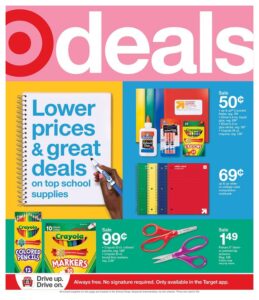
You can find Target’s weekly specials [HERE]. Deals vary by location, so make sure to check out the ads beforehand. At some locations they are offering Crayola markers and crayons for $0.99, kids scissors for $1.49, paint sets for $1.99, plastic folders for $0.50, and notebooks for $0.69. They also offer a 2-pack of kids’ fabric face masks for $4.
Aldi
I love Aldi! I love my low bill when I leave. I love the savings on my groceries. I also love their seasonal goods, including their school supplies this time of year.
Their weekly ads will show their specials, and when they expect to get items in stock. Aldi also gives you a sneak peek of what will be the next week’s specials so you can plan ahead. I suggest going on the first day the school supplies are stocked because these specialty items can sometimes sell out quickly. While some stores may restock, for some locations, once they are gone, that’s it.
Aldi is another excellent location for tissues and disinfecting wipes, which schools will most likely ask for in abundance this year.
 I’ve also seen great deals on character backpacks, lunch boxes, insulated food containers, and kids reusable water bottles. They even have lunch storage containers with compartments for their entree and sides.
If you need additional learning materials for at-home, Aldi offers educational puzzles and elementary age perforated page activity books. My daughter is working through their kindergarten book right now. They review letters, shapes, colors, and sight words. Aldi also had a summer review activity book this year.
Walmart
I’ll be the first to say that Walmart wasn’t my favorite place to shop. While they have low prices, our local Walmart always had long lines and not the best customer service.
However, when Walmart introduced its grocery pickup with a convenient app where I could do my grocery shopping in my sweatpants at home, I became a Walmart shopper.
Most moms will agree it is no fun running errands with kids in tow. In and out of the car seats in the heat – no, thank you! Getting Walmart’s low prices without standing in lines is a massive win in my book. Check out their back to school specials [HERE].
Dollar Stores
Check the Dollar Store, Family Dollar, or Dollar Tree for back-to-school items like basic calculators, planners, colored pencils, or clipboards. This will help you save money while still getting a great item. Most stores stock school supplies year-round, including name brand items at some.
Amazon
 Amazon often has the lowest price on items, so make sure to check items against Amazon. I’ve found if you’re ordering multiple of an item (like glue, markers, etc.) they have better prices. It also saves you on spending extra money on gas running around town, especially if you’re already paying for Prime.
We’ve included an Amazon shopping list to help you get started, click HERE.
Office Supply Stores
Office supply stores can have a reputation for being a bit expensive. They offer such a wide range of products that their draw is they have everything you need, not that they are the most inexpensive. However, during back-to-school, they will run specials. I’ve seen sets of colored pencils on sale for half of what they are listed for at other retailers. Check out their ads. If you can pop in quickly for a few items while you’re running errands, it may be worth the trip.

Craft Stores
Check out stores like Michael’s, Hobby Lobby, or JOANN for school supplies.
BONUS – These stores usually have coupons that you can easily find online. I have the Michael’s and Hobby Lobby apps on my phone, so I can pull up their weekly coupon at checkout. If you don’t have the app, don’t worry about printing the coupons ahead on time, just make sure you have their website pulled up with the online coupon.
How to Shop for School Supplies
We’ve talked about when and where to shop, but it’s also important to consider how you shop. If you buy everything in one location and pay no attention to the sales, you leave savings on the table.
Order in Bulk
If you have multiple kids or have a friend who is willing to split supplies, look at ordering in bulk to save money. Some retailers (ex. Amazon) will have a multi-pack of paints, sets of markers, scissors, etc. that you can purchase. Purchasing in bulk will help save you money per set.
This also applies to items like Clorox wipes, sanitizer, and tissues. If you buy a multi-pack, you save per item, and you can keep the extra for your household stock.
Look at What You Already Have
 If you’re like me, you love a good deal. So when I see something on clearance that I know we will need soon, I will scoop it up. Don’t forget to check if you already have it at home before you buy more.
Since kids were sent home early last year, chances are there are some unused items they can take this year. For instance, I have a few glue sticks that my daughter never used. Look through last year’s supplies for unused items that you can reuse this year.
Generic Brands
Don’t shy away from generic brands. There is a stigma that generic is inferior to name brands. However, that is not the case.
Some generic brands may not be a good deal over time if you have to replace them quicker or don’t work well. However, some stores (ex: Target) are making quality products (markers, colored pencils, etc.) that will save you money but still deliver the performance that your child needs.
Store Pickups and Online Shopping
Schedule store pickups for your school shopping. By utilizing curbside pick up options from Walmart, Target, Aldi, and more, you can save yourself time and money.
If you don’t have to go into each store, you are more likely to shop around and choose different stores for the best prices on individual items. You can add them to your current grocery pick up, so it doesn’t cost you an extra trip.
If you want to avoid the stores altogether, we’ve included an Amazon shopping list with some of our suggestions. No running around town – just click HERE and send!
Coupons
 COUPONS! Couponing may not be your normal habit, but back-to-school is a great time to look for coupons that could save you money on supplies.
Check magazines, newspapers, or online coupon sites for options. On our budgeting page on the I Was Broke. Now I’m Not. website, we have links to several online coupon sites. This is a great place to start.
If a store has an app (like Michael’s or Hobby Lobby that I mentioned earlier), check it before shopping to see if they have any special deals. You can find great deals and look for in-store coupons. For instance, the Target app will show you their weekly specials, and you can add Target Circle Offers to save even more.
Loyalty Rewards
As you’ve been purchasing items, you’ve been earning rewards at a lot of stores throughout the year. Look to see what stores you’ve earned reward points and exchange your points for school supplies, clothes, or shoes.
You may want to check if you have credit card points to redeem. If so, choose a store where you’ll do back-to-school shopping and get a gift card there. We’ve redeemed our points for Walmart and Target gift cards.
Price Matching
Does a store that you’re shopping at offer price matching? Stores like Staples, Target, Kohl’s, Office Max, and Office Depot offer price matching. Check each store to learn about its policy and restrictions.
Happy School Supply Shopping
I know making decisions about school during COVID-19 has been difficult and stressful for parents and school officials alike. So, however, and whenever your kids return to school this fall, we hope you find this helpful. Remember, there is no “right way” for everyone, so give yourself and others grace! Happy (and thrifty) shopping!
How have you saved money back to school shopping?
5 Ways to Save Money Without Selling Anything
When the economy takes a down turn, one of the best ways to “weather the storm” is to save money! In this post I will share the top five ways that we see people saving lots of money.
I believe that if you apply these five items, you will save over $1,000 a year. Don’t believe me? Try them out!
1. Home and auto insurance
I know that I have mentioned this several times on the blog, but it is so true! I have had HUNDREDS of stories of people telling me about how much money they have saved by getting new quotes.
Many of them never had to change their current insurer because they took the better quotes back to their current insurer and demanded a better deal. Sweet!
On our Next Steps Insurance page we have links to get both Auto and Homeowner’s insurance quotes. These allow you to fill in a bit of information and receive quotes without the hassle of having to call around to multiple different companies.
Remember when LendingTree said “When banks compete, you win!”? Well, the same is true for insurance companies. Be sure to get your home/renter’s insurance quoted along with your auto insurance because bundling them together will save you 10% – 30%.
2. Life insurance
It is incredible the number of people who have dependents reliant upon their income yet do not have life insurance. According to LIMRA only 59% of Americans have life insurance, and have of those with insurance have inadequate coverage.
As a teacher and speaker on the subject of personal finances, I have seen many examples of inadequate/no life insurance. The impact that it has on the surviving dependents is devastating. I have also seen instances where there was adequate insurance. The result is much different!
I have also seen a lot of people who are paying way too much on life insurance. Some people are paying thousands of dollars a year in life insurance premiums who tell me that the cash value will be worth $1,000,000 when they retire. I tell them that this is great, but if they would have term life insurance and invest the difference in cost, they would have $10,000,000.
I recommend term life insurance equal to eight to ten times one’s annual take-home pay. For healthy people term life insurance is SO CHEAP. I personally carry thirty year level term policies on my bride and me.

You can obtain online quotes without speaking to anyone HERE
Go ahead and check them out. If you do not have life insurance and you have dependents who are reliant upon your income, purchase a policy ASAP. If you already have life insurance, compare the costs.
My bet is that you will save a ton of money.
3. Zero-percent balance transfer credit cards
I do not know how the credit card industry has been so effective at teaching Americans to believe that 15% is a good interest rate. But they are great at it! I cannot tell you the number of times I have heard the following statement during a financial counseling appointment:
“The interest isn’t bad on this card. It is only 17%.” Or 13%. Or 11.99%. Or … You get the picture.
I used to say the same thing (when I was BROKE). I got “unBROKE” by challenging my belief system and realized that I was allowing myself to be legally robbed of my money!
If you are paying high interest on a credit card, you should seek to restructure that debt. One great way to restructure debt is to play the “surf the balance” game. Move the balance to a zero-percent balance transfer credit card and then work like crazy to pay it off. If it is not paid off by the end of the zero-percent period, surf it again. This ensures that all of your payment goes to reduce the principal balance of the debt.

There are several 0% Balance Transfer Credit Cards located on the “Next Steps” tab (HERE). Move the balance and make progress toward 100% debt freedom!
You will save a ton of money by restructuring high interest debt!
4. Online savings accounts
Do you have money in your savings account? If not, it should by your TOP PRIORITY. $1,000 as a minimum or $2,500 if you have kids or a house. I repeat – this should be your TOP PRIORITY!
For those with money in savings, how much interest is your bank paying you? If it is a local bank, it is likely that the interest rate is very, very, very low (close to 0%). Online banks pay much higher interest because they do not have to pay the costs of maintaining local branches (people, buildings, etc). These online banks pay around 5X – 8X the national savings interest rates of other banks. I hold all of my savings in online banks and have done so since 2007. They are FDIC-insured and are very easy to use.

There are several excellent online banks. Click HERE to see the online banks I use or recommend.
The bottom line is that your money should make you money – the most money possible. My online banks allow me to do that for all money that I plan on using within the next five years.
5. Groceries and cash envelopes
Cash envelopes allow me to save a TON of money. How? I have a written spending plan that my bride and I prepare every month. In this written plan there are several items that I tend to be impulsive with. Groceries, dining out, clothing, entertainment, and spending money are the top five impulsive categories for me (can I get a witness?). To control my impulsiveness, we pull that money out in cash. We stow away the debit card and only allow cash to be used to purchase items in our impulsive categories.
This one move saved us over $200 a month in groceries alone! You can read more about how to start with cash envelopes HERE.

You can also use coupons to save a ton on groceries. In fact, my team has prepared an entire section of money saving tips for groceries under the Next Steps budgeting tab. You can check it out HERE.
Our Top 5 Ways to Save Money
Saving money, especially a large amount of money, can seem impossible. Our hope is that after reading this blog post you come away with practical ways to save money NOW!
Some of these savings ideas will take some work. No one ever says, “I’d love to be on the phone with different insurance companies all day!” However, if it means saving $500 or more each year those phone calls are worth it. Not to mention, most companies now offer online quotes that eliminate the hassle of waiting on hold. We’ve heard from numerous people that after they called for new quotes not only are the saving money, but they’re also getting better coverage.
Decide to take action today. Think about the last time you got a new insurance quote. If you have balances on credit cards look into transferring them over. Move your savings to an online bank to earn more interest and save on banking fees. Identify areas where you overspend, and start using cash envelopes and coupons for those things.
I believe that by pursuing these five money saving areas you can save $1,000 or more. Tell us how you did!
You Can Be Debt-Free
I have found that a vast majority of those who sign up to attend the Financial Learning Experience are living paycheck-to-paycheck AND carrying debt. In fact, statistics from surveys I have conducted show that 72% of those attending my classes are living paycheck-to-paycheck. Of those 72% living paycheck-to-paycheck, 24% are BEHIND on payments.
Only 3% felt that they are doing well financially.
This is a NATIONAL problem. No matter where I go, I see the trappings of debt – marriages failing, stress, depression, and hopelessness. And all of this is happening in one of the wealthiest countries on the planet! This is entirely unacceptable!
So, as part of my crusade to help America become debt-free, I am going to share the process I followed to become debt-free.
Before I get started, I want to ask you these questions.
- Would you join me in my crusade?
- Would you share this with others?
- Would you commit to become debt-free?
I WANT YOU TO BECOME DEBT-FREE!!! It changes your life! It enables you accomplish far more than you ever thought possible with your personal finances! It allows you to go do exactly what you were put on earth to do – regardless of the income!
Step 1 – Understand WHY you want to be debt-free!
I believe this is the most important step in becoming debt-free! In the hundreds of financial counseling sessions I have held, it is amazing how many people do not have a plan for their lives.
I ask them, “Why do you want to win with your money?” and they stare at me like I am from outer-space.
“Why?” they stammer back at me.
Seriously, I believe that it is the first time that many of these people have ever seriously thought about what they want to accomplish with their lives. As a result, they are bumbling through life just “trying to make it through the day”.
What a miserable way to live!
I cannot overstate this fact – IF YOU AIM AT NOTHING, YOU WILL HIT IT EVERY SINGLE TIME!
Write out your hopes and dreams.
When Jenn and I wrote down our hopes and dreams on paper it opened our eyes to the fact that our money management (or lack of) was literally ROBBING us of our future! We wanted to move back to Anderson, SC to take a job that paid way less than what we were making, but every single dinner at Outback was robbing us of that opportunity. Every single debt payment went off to make the bank wealthy while at the same time robbing us of our God-given dreams!
That made me MAD! It made me FURIOUS! It made me realize how incredibly STUPID I was to be managing our money so crazily! I had $755 PER MONTH going out to pay car debt, credit card debt, and student loan debt. Add in the stupid house payment, and I had over $1,700 per month running off to make the bank wealthy!
By writing out our hopes/dreams on paper, Jenn and I were motivated to manage our money differently. It caused us to view debt differently.
Are you ready to get rid of your debt?

Take your first step today by print out THIS FORM and filling out your own hopes/dreams. If you are married, you need to do this separately and then take time to discuss it with each other.
By the way, one of my hopes/dreams is for you to become debt-free!
What has kept you from attacking your debt?
Step 2 – List your debts.
During financial counseling sessions, it is a guarantee for any person who has debt that I will calculate their debt freedom date. You should see people’s reactions as I put together a list of their debt! Their reactions relay to me the true facts of debt. Here are some very common reactions that I see or hear.
- Hiding their eyes
- “Oh no!”
- “I’ve never added it up.”
- “This is scary.”
- Moving to a defensive position as if to guard themselves against the debt
- Turn their head so they don’t have to look at the debt total
I KNOW that it can be scary to total up debt. The mere fact that it is so scary tells me two things:
1. People do not like debt.
2. People have not been paying attention to their finances and do not have a well-defined plan for their life. Otherwise, they would not have incurred most of the debt. It is literally ROBBING them of their financial future!
Here is what I say to them – “If you don’t know how many heads the dragon has or how large the dragon is, how can you effectively defeat it?”
It is time to slay the dragon. Use THIS FORM to prepare a well-organized list of your debt.
Why is it so scary to total up debt?
Step 3 – Calculate your debt-freedom date.
It is really very simple to calculate your Debt Freedom Date. You need two numbers to calculate your Debt Freedom Date – Total Debt Owed and Total Monthly Payments. I pretend that there is actually only one debt – with one big balance and one big monthly payment.

Look at the sample debt list below. This family will be debt-free in just 33 months!
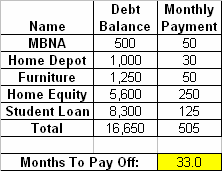
In the TOOLS section, there is a free tool called the Debt Freedom Date Calculator. If you enter your debts and monthly payments into this tool, it will calculate your Debt Freedom Date for you! If you don’t have Microsoft Excel, click HERE for a web-friendly version.
How many months until you are debt-free?
Step 4 – Establish accountability to become debt-free.
The strongest among us can still fall to temptation! You could be making fantastic progress toward debt-freedom and then a new truck pulling a new boat passes you on the road. If you are not careful, you will also be pulling a new truck and boat down the road!
There are two key ways to ensure you are held accountable to your goal of debt-freedom!
If married, work together with your spouse. If unmarried, have someone you trust (someone who has won with their money) hold you accountable!
There is incredible power when you work together with your spouse toward debt-freedom! It is a common goal that will unify your marriage and cements your commitment to managing your resources together.
I have also found that when I have a bad case of the “I Wants” and “I Gotta-Have” Jenn does not. She shuts me down! Then, when Jenn gets a bad case of “I Really Want This” I do not. I shut her down! Why? Because we are not doing debt! We are THROUGH with it!!!
Plan your spending every single month!
Planned money goes farther than unplanned money! Every single month Jenn and I sit down TOGETHER and spend every single dollar on paper before we are paid. Don’t miss that – that was good! Every. Dollar. On. Paper. BEFORE. We. Are. Paid.
From the day that Jenn and I started budgeting, we have not incurred any new debt. In fact, we became debt-free (minus the house) in just 14 months!
I can tell you this. I HATED the idea of budgeting and now all I do is yell from the mountaintops about how important it is and how EZ it is to budget! There are FREE budget forms that are available HERE. Use one of them to start your journey to debt freedom!
Your budget will hold you accountable. I wouldn’t be surprised if it helped you free up $200 – $500 per month to attack your debt even harder. It did for me!
If you’re already debt-free, how did accountability help you stick to your debt-freedom plan?
Step 5 – Secure your debt-freedom.
Save at least $1,000 before attacking your debt!
I have seen so many people calculate their Debt Freedom Date and get all fired up about attacking their debt. They sell everything and everyone in sight. They can’t shut up about getting out of debt. It is all they talk about with their spouse. They have even sold their Clay Aiken AND Celine Dion albums!
Everything goes great for two months. They smile every time I see them. “This is awesome”, they tell me enthusiastically.
Five months later, they avoid me. When I ask them what is up, they say something like, “Well, Johnny broke his arm and the emergency room bill and doctor bills cost me $1,500. I had no savings so now I am right back where I was – falling back into more debt.”
How demoralizing is it to attack debt so fervently and then have to go right back into debt? It is AWFUL! Don’t do that! Instead, save up at least $1,000 into an emergency fund before attacking your debt and THEN you can attack your debt all you want!
What happens if you have an emergency pop up while you are attacking your debt? You can use the emergency fund to cover the expense. To replenish the emergency fund, slow down on the debt pay-off plan until you have the $1,000 back in the emergency fund!
By the way, if you have a house, kids, or more than one car I highly recommend $2,500 for your emergency fund.
Secure your debt freedom plan with your emergency fund!
Congratulations! You now know the process that Jenn and I used to become and STAY debt-free! You are now equipped!
What are you going to do now that you are equipped to become debt-free?

You can be debt-free!
I want to equip you to become debt-free! Jenn and I became debt-free in 14 months by following this process, and I can tell you this – there is NOTHING like living life without the trappings of debt!
Let’s review the steps to debt freedom.
Step 1 – Understand WHY you want to become debt-free! You greatly improve your chances of becoming debt-free when you understand the reasons that you are making sacrifices in lifestyle!
Step 2 – List your debts. If you don’t know how large the giant is, it makes it really difficult to understand the overall situation!
Step 3 – Calculate your Debt Freedom Date. When you have put together your Debt Freedom Date calculation, print it out! Put it on the refrigerator! As you pay off each debt, draw a big line through it! You will not believe the conversation this will start with your family and friends as they come over to visit.
Step 4 – Establish Accountability. If married, hold each other accountable. If unmarried, have someone who has won with their own money and has your best interest in mind.
Step 5 – Secure Your Debt Freedom. Before attacking your debt save at least $1,000, or $2,500 if you’re married with children, so you have an emergency fund.
I hope that you have taken the time to write out your plans, hopes, and dreams for your life. Knowing these will help you stay the course. It will motivate you to say no now so you can win later!
March 2020 Update From I Was Broke. Now I’m Not.

Do your finances cause you frustration, fear, and anxiety? Discover how you can handle financial anxiety and become more comfortable dealing with money.
**CLICK HERE TO LEARN HOW TO DEAL WITH FINANCIAL ANXIETY
DEBT!!! Is it all equal? Are there different kinds of debt? What type of debt should you avoid, and is there any debt that’s ok to have? Everyone has a different opinion, so we’re breaking it down for you.
**CLICK HERE TO LEARN ALL ABOUT DEBT

Are you making progress when it comes to budgeting, but then something happens that blows up your budget? Discover how to prevent issues from messing with your financial progress.
**CLICK HERE TO FIND TIPS FOR PAYING CASH FOR YOUR VACATION
We’re sharing all our money saving tips. If your monthly budget is tight, this is for you! Check out ways you can save money in your budget now!
**CLICK HERE FOR MONEY SAVING TIPS
DON’T FORGET YOUR MARCH BUDGET
If you still need helping creating this month’s budget, check out our free budgeting tools HERE.
Don’t forget these expenses in your budget:
- St. Patrick’s Day
- Spring Break
- Easter
- Taxes
- New Clothes for Warmer Weather
- Outdoor Activities
- Yard Upgrades [mulch, plants, patio furniture]
- Christmas 2020
- Summer Vacation Savings